AI Product Updates Daily
2026/05/21 08:09:52@侯佳林
AI Product Updates Daily — May 21, 2026
Google I/O afterglow: Gemini 3.5 Flash goes GA, subscription tiers drop to $7.99/$19.99/$99.99, and Gemini Spark opens to Ultra users next week. Andrej Karpathy joins Anthropic to lead Claude pre-training. GitHub ships a standalone Copilot app and discloses a 3,800-repo breach via a poisoned VS Code extension. OpenAI begins confidential IPO filing prep at a $730B valuation.
Today's digest covers the continued fallout from Google I/O 2026, a landmark hire at Anthropic, GitHub's double-barreled developer news, and an IPO filing that will reshape the AI sector's capital story. Three themes run through May 21: Google's subscription overhaul reaching consumers, agentic coding tools claiming the desktop, and enterprise AI deals getting bigger and faster.
Gemini 3.5 Flash is generally available
Gemini 3.5 Flash launched into GA at Google I/O on May 19–20, now available through Google AI Studio, the Gemini API, and Android Studio.1 On the Terminal-Bench 2.1 coding benchmark it scores 76.2%, and on GDPval-AA it posts 1,656 Elo — both above Gemini 3.1 Pro — while costing under half the price of comparable frontier models. The model is optimized for long-horizon agentic tasks and is the default backbone for Google Antigravity.
Gemini 3.5 Pro is running internally and is expected to ship publicly next month.1
Gemini Omni is live for subscribers
Gemini Omni, Google's any-input-to-video model, is now available to all Google AI Plus, Pro, and Ultra subscribers via the Gemini app and Google Flow.1 Omni Flash is also free for YouTube Shorts Remix and the YouTube Create app for users 18 and older. The model generates video from text, image, audio, or video prompts and embeds an undetectable SynthID watermark in all outputs; verification is now live in Google Search and rolling out to Chrome in the coming weeks.
Google's subscription tiers are restructured and cheaper
Google overhauled its AI subscription lineup at I/O, with prices lowered across the board:2
| Tier | Price | Key inclusions |
|---|---|---|
| Google AI Plus | $7.99/mo | Gemini 3.5 Flash, Gemini app with Omni, Google Flow with Omni, Daily Brief, AI Inbox in Gmail |
| Google AI Pro | $19.99/mo | All Plus features + YouTube Premium Lite ($8.99 value), Google Pics preview |
| Google AI Ultra | $99.99/mo (was $250/mo → was $200/mo) | All Pro features + 5× usage limits, 20 TB storage, priority Antigravity access, Gemini Spark (Beta, US only next week) |
Quota now measures actual compute consumed rather than prompt count, and refreshes every 5 hours instead of daily. When the top-tier model cap is hit, the system falls back to a lighter model rather than cutting access.
Gemini Spark enters beta for Ultra subscribers
Gemini Spark, the 24/7 autonomous personal agent built on Gemini 3.5 and Google Antigravity, opens to US Google AI Ultra subscribers next week.3 It runs in the background after a device is locked, handles email and short-message replies, and can spawn custom sub-agents. Broader rollout continues through summer.
Daily Brief is live for US subscribers
Daily Brief, the overnight agenda-synthesis agent, launched today for all US Google AI Plus, Pro, and Ultra users in the Gemini app.3 It reads Gmail, Calendar, and tasks overnight, ranks priorities, and surfaces suggested actions each morning. A Google account connection is required.
Google Antigravity 2.0 ships with new developer tools
Antigravity 2.0 arrives as a standalone desktop app, bringing multi-agent orchestration: users can run a coding agent and a brand-asset generation agent simultaneously.1 Alongside it, Google released:
- Antigravity CLI — terminal-native, no GUI required
- Antigravity SDK — programmatic access to Google's agent framework, deployable on custom infrastructure
- Managed Agents via Gemini API — a single API call spins up a remote Linux sandbox where an agent can browse the web, run code, and manage files; built on Gemini 3.5 Flash
Antigravity connects directly to Google Cloud projects under enterprise terms. Existing Gemini CLI users are advised to migrate; a migration guide is published.
Google AI Studio gets Android app development and Workspace integration
Starting today, Google AI Studio supports native Android app development directly from a build tab — including in-browser emulator preview, ADB debugging, and one-click publish to a Google Play internal test track.1 New developers get two free Cloud deployments with no credit card needed. The tool also now integrates with Google Workspace: apps built in AI Studio can read Drive files, Sheets data, and team Docs directly.
Gemini for Science opens in Google Labs
Three experimental research tools are available at labs.google/science starting May 19:1
- Hypothesis Generation — multi-agent idea tournament for research questions (citations verifiable inline)
- Computational Discovery — parallel evaluation of thousands of code variants for modeling tasks (epidemiology, solar forecasting)
- Literature Insights — searches scientific literature, organizes results into a structured table, and exports to reports, slides, or audio summaries (built with NotebookLM)
Separately, Science Skills integrates 30+ life sciences databases (UniProt, AlphaFold, AlphaGenome API) as tools callable from Antigravity, compressing multi-hour bioinformatics workflows.
OpenAI
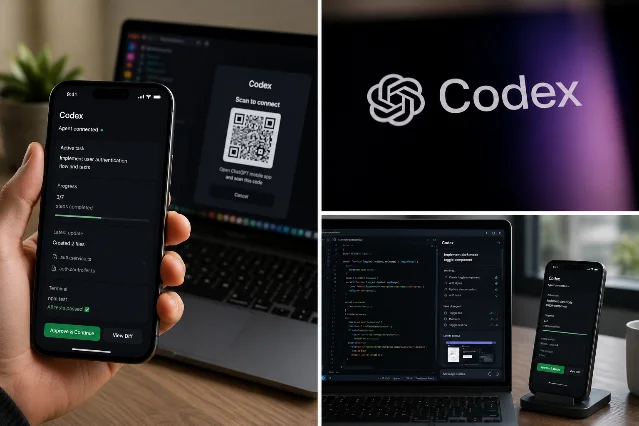
Codex mobile access is live inside ChatGPT
OpenAI's Codex coding agent is now accessible on iOS and Android through the existing ChatGPT app — there is no separate download.4 The mobile interface is a remote control for a desktop Codex session, not a mobile IDE: users can start tasks, approve or reject agent actions, and check progress from their phone. Files and credentials remain on the local machine; only diffs and status updates pass over a secure relay.
The pairing works with macOS Codex today; Windows support is listed as coming soon. All ChatGPT plans, including Free and Go, get access during this preview period — paid plans receive higher request limits.
Compared with Claude Code's mobile client (also inside the Claude app), Codex's differentiator is Computer Use: the desktop agent can interact with web apps and GUI tools beyond the terminal, while Claude Code counters with Agent Teams for multi-agent coordination on large codebases.
OpenAI is preparing a confidential IPO filing
OpenAI is working with Goldman Sachs and Morgan Stanley to prepare a confidential IPO filing, targeting submission in the coming weeks.5 If filed shortly, the public offering could land as early as September. OpenAI's current private-market valuation stands at $730 billion from its most recent funding round. The company declined to comment beyond noting it "regularly evaluates a range of strategic options."
Anthropic
Andrej Karpathy joins to lead Claude pre-training
OpenAI co-founder and former Tesla AI director Andrej Karpathy confirmed on X that he has joined Anthropic, starting this week.6 He will report to Nicholas Joseph and lead a new team focused on accelerating Claude's pre-training using Claude itself.
"I think the next few years at the frontier of LLMs will be especially formative. I am very excited to join the team here and get back to R&D. I remain deeply passionate about education and plan to resume my work on it in time." — Andrej Karpathy
The hire follows Anthropic passing OpenAI in business adoption (34.4% of companies tracked by Ramp's May 2026 AI Index, up from a lower base 15 months ago) and comes one week before Anthropic's Code with Claude developer conference.
Bristol Myers Squibb deploys Claude across 30,000 employees
Bristol Myers Squibb announced a strategic agreement on May 20 to position Claude Enterprise as its company-wide AI platform, rolling it out to more than 30,000 employees across drug discovery, clinical development, regulatory, manufacturing, and commercial operations.7 The deal makes BMS one of the largest pharma deployments of a frontier AI model to date.
GitHub / Microsoft
GitHub Copilot standalone app enters technical preview
GitHub launched the Copilot app in technical preview on Windows, macOS, and Linux for paid Copilot subscribers.8 The app operates entirely outside the IDE. Work starts from issues and pull requests already in a repository; each session has its own branch, file state, and conversation. Key capabilities include:
- Agent Merge — monitors CI checks, downloads failure logs, resolves merge conflicts, and auto-pushes fixes before merge
- Multi-session support — run multiple agent sessions across repos simultaneously, each isolated and trackable in real time
- MCP server extensions — agents can be extended with custom skills and MCP servers
The move puts GitHub on the same desktop-client tier as Cursor and Claude Code.
GitHub Copilot billing switches to AI Credits on June 1
Starting June 1, GitHub Copilot will bill by AI credits — actual compute consumed — rather than a flat seat fee.9 Teams using premium models like Claude Opus or GPT-5 Codex at scale face bills roughly 9× higher than current flat-rate pricing under the previous plan. The change affects paid Copilot Individual and Enterprise seats; light users on simpler tasks will see smaller increases.
GitHub confirms 3,800 internal repos stolen through poisoned VS Code extension
GitHub disclosed on May 20 that an attacker gained access to approximately 3,800 internal repositories via a poisoned VS Code extension installed on an employee device.10 The stolen repositories contained infrastructure configurations, deployment scripts, and staging credentials. GitHub has detected and contained the breach, removed the malicious extension versions, isolated affected endpoints, and rotated compromised keys overnight.
The same threat group (TeamPCP / UNC6780 per Google Threat Intelligence) simultaneously hit the Nx Console VS Code extension (2.2M installs, stealing Claude Code credentials among others) and published 639 malicious npm package versions, and compromised Microsoft's
durabletask Python SDK on PyPI — all within 24 hours, all in the Microsoft developer supply chain.Recommended immediate actions for affected teams: rotate any plaintext secrets or GitHub tokens in private repos, pin GitHub Actions to full commit SHAs, audit VS Code extension auto-update policies, and rotate GitHub-issued OAuth app secrets and OIDC trust relationships.
Upcoming to watch
- Gemini 3.5 Pro public release: expected in June
- Anthropic Code with Claude developer conference: next week
- Gemini Spark broader rollout and MCP third-party integrations: throughout summer
- GitHub Copilot credit billing goes live: June 1
- OpenAI IPO confidential filing window: coming weeks; potential public offering as early as September
参考ソース
- 1100 things we announced at I/O 2026
- 2Google I/O 2026: AI subscription tiers are now cheaper
- 3Confused by Google's new AI features
- 4OpenAI Codex mobile app: AI coding agent now available on iOS and Android
- 5OpenAI prepares to file for an I.P.O. in coming weeks
- 6Anthropic hires OpenAI co-founder Andrej Karpathy to lead Claude pre-training
- 7Bristol Myers Squibb announces strategic agreement with Anthropic
- 8GitHub Copilot gets its own app — and it's more than a coding assistant
- 9GitHub Copilot's new pricing could raise costs 9x from June 1
- 10GitHub confirms 3,800 internal repos stolen through poisoned VS Code extension
このコンテンツについて、さらに観点や背景を補足しましょう。